
ST. GERTRUDE'S PRAYER
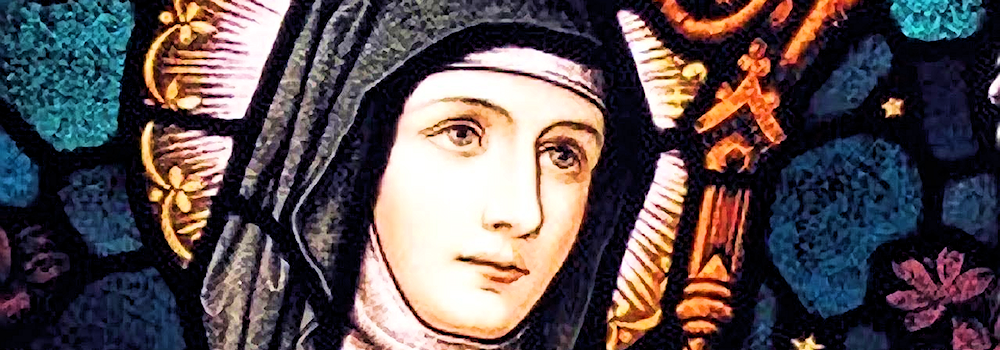
Born in Germany on January 6, 1256, St. Gertrude the Great, also known as St. Gertrude of Helfta, ultimately dedicated her life to God as a Benedictine nun. Her profound prayer life earned her recognition as both a mystic and a respected theologian.
While details of her early life are sparse, historical accounts indicate she entered the Cistercian monastery school at Helfta in Saxony at the age of four. The school was governed by Abbess Gertrude of Hackerborn. The Cistercian order sought to reform Benedictine monasticism by enforcing a stricter adherence to St. Benedict's original Rule. It remains uncertain whether Gertrude's parents offered her as an oblate—a layperson consecrated to God's service—or if she arrived at the monastery as an orphan.
Young Gertrude was placed under the care of St. Mechtilde, the abbess's younger sister. The two formed a powerful and enduring bond, with Mechtilde becoming a significant influence on Gertrude's spiritual development.
Known for her engaging personality, Gertrude formally joined the Benedictine Order at Helfta. She pursued a comprehensive education, becoming fluent in Latin and developing deep knowledge of Scripture and the writings of the Church Fathers, such as Augustine.
A pivotal transformation occurred in 1281 when, at 25 years old, Gertrude began experiencing a series of visions that would persist until her death. She regarded this event as her spiritual rebirth, shifting her focus from secular studies to Scripture and theology. Embracing this new path with zeal, she began writing to guide others spiritually.
One of her most notable visions, recorded in her writings, took place on the feast of John the Evangelist. Resting her head near Christ's side wound, she heard the beating of his heart. She asked St. John if he had also experienced this at the Last Supper; he replied that this revelation was reserved for a future time when the world needed to rekindle its love for God.
Gertrude emerged as a leading 13th-century mystic. Alongside St. Mechtilde, she practiced "nuptial mysticism," viewing herself as the bride of Christ. She demonstrated profound charity toward all people and maintained a deep solidarity with the souls in purgatory.
She was present at the deaths of both Abbess Gertrude of Hackeborn in 1291 and her beloved St. Mechtilde in 1298. Despite her own declining health, Gertrude's devotion to the Lord never wavered. She once reflected on her transformation: "Until the age of 25, I was a blind and insane woman… but you, Jesus, deigned to grant me the priceless familiarity of your friendship by opening to me in every way that most noble casket of your divinity, which is your divine Heart, and offering me in great abundance all your treasures contained in it."
St. Gertrude died on November 17, 1301, a virgin, forever united with her Divine Bridegroom.
Throughout her life, Gertrude was a prolific writer, though only a portion of her work survives. Her most extensive extant text is Legatus Memorialis Abundantiae Divinae Pietatis (The Herald of Divine Love). Her other surviving works include a collection of Spiritual Exercises and Preces Gertrudianae (Gertrudian Prayers).
The Herald of Divine Love is structured in five books. The second book, considered the core of the work, was authored entirely by Gertrude and is significant for its detailed accounts of her visions and its veneration of the Sacred Heart of Christ. The other four books are believed to have been compiled by other nuns in her community.
According to Catholic Tradition, the Lord Told St. Gertrude, the 13th century German nun and great mystic that this prayer - when piously recited - would release 1,000 souls from purgatory. Some Church authorities state that calims of a specific number cannot be confirmed but that a great number of souls would be released.
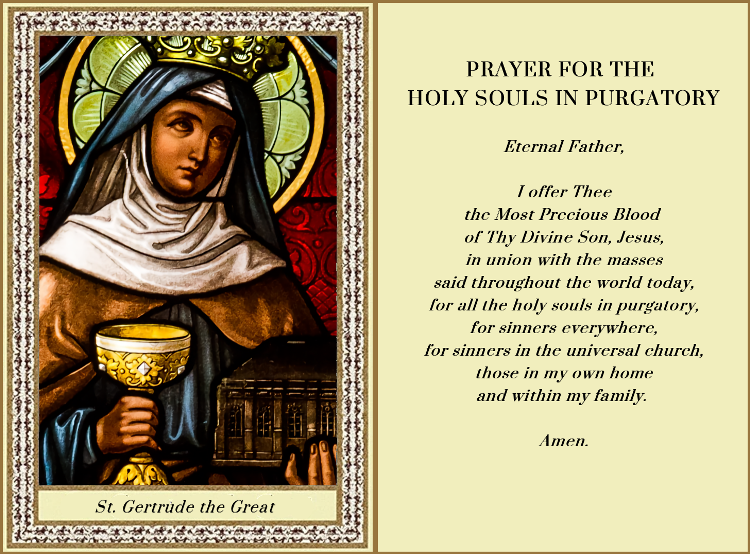
CLICK HERE TO DOWNLOAD PDF PRAYER CARD